The Karana Journey
At Karana Dynamics, our strength lies in our exceptional team of innovators and experts. We are a diverse group of passionate professionals dedicated to pushing the boundaries of dynamics modeling and simulation technology and delivering groundbreaking solutions. Our collaborative spirit and commitment to excellence drive us to achieve remarkable results and make a lasting impact in the tech industry. Together, we are shaping the future with creativity, precision, and a shared vision for success.

Mission

We bring over 30 years of experience in building simulation tools that have led to successful missions, from spacecraft such as Cassini, that reached the farthest parts of our solar system, to the rovers that are exploring the vast surfaces of Mars and the Moon. We thrive on solving engineering problems with demanding and unique challenges. Our team includes leaders and architects of some of the most advanced NASA simulation tools, and inventors of novel multibody dynamics frameworks and computational methods.
curiousity rover mars on martian landscape nasa jpl mission
Nikhil Jain
CEO & CO-FOUNDER
Nikhil is a seasoned engineering leader with extensive experience in global operations. He has successfully scaled products and organizations at top tech companies like Samsara and Apple, driving innovation and efficiency. Nikhil holds Master's degrees from MIT and SUTD, as well as a BSE in Mechanical Engineering from UC Berkeley. He is passionate about technology, sports, and outdoor adventures.
Dr. Abhinandan Jain
CHIEF TECHNOLOGIST & Co-FOUNDER
Abhi is a leading researcher in the field of multibody dynamics, and formerly a Senior Research Scientist at NASA Jet Propulsion Laboratory (JPL). He founded and led JPL's DARTS Lab for the development of  advanced modeling and simulation capabilities for space and robotics missions. He is also the inventor of the Spatial Operator Algebra methodology for multibody dynamics. He has been a recipient of NASA's Exceptional Engineering Medal, and the NASA Software of the Year award.
Dr. Carl Leake
SENIOR TECHNICAL STAFF
Carl Leake is a passionate aerospace engineer skilled in flexible body modeling and multibody dynamics simulation. He holds a Ph.D. from Texas A&M University and a B.S. from Embry-Riddle Aeronautical University. At NASA’s Jet Propulsion Laboratory (JPL), he advanced multibody dynamics simulations and flexible body modeling, contributing to projects like a snake-like robot for Enceladus, a next-gen rotorcraft for Mars, and servoelastic modeling for the Space Launch System (SLS). His research interests span flexible multibody dynamics, the Theory of Functional Connections, and the intersection of Aerospace Engineering and Computer Science. Outside of work, he enjoys climbing, biking, backpacking, and the outdoors.
Aaron Gaut
Senior TeChNical Staff
Aaron is a versatile software engineer with expertise in JavaScript, Python, Go, C++, and more. He has significant experience in both open source projects and high-profile organizations like NASA JPL, where he developed multi-mission software simulators. Aaron holds dual B.S. degrees in Computer Science and Mathematics and Statistics from Cal Poly Pomona, and actively contributes to various FOSS projects in his spare time.
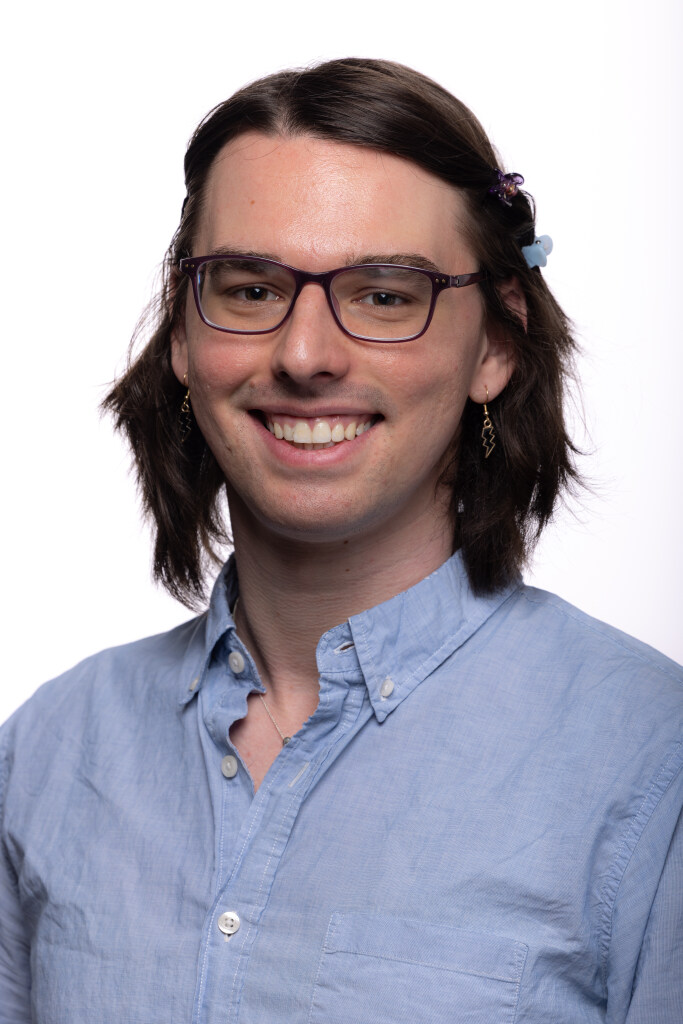
Dr. Conlain Kelly
SENIOR TECHNICAL STAFF
Conlain (they/them) is a computational scientist specializing in multi-physics simulation, statistical continuum mechanics, and scientific machine learning. They hold a Ph.D. in Computational Science and Engineering from Georgia Tech and a B.S. with a double major in Applied Mathematics, Engineering and Physics & Computer Science from the University of Wisconsin-Madison. Following their doctorate, they completed a postdoctoral fellowship at the National Renewable Energy Laboratory, where they focused on generative AI approaches for inverse materials design, with an emphasis on photonic metamaterials. Their research interests center on the intersection of numerical methods and machine learning, particularly in the context of system identification, controls, and inverse design.